.png)
A cracked tooth is a tooth with a fracture running through the enamel, the dentin, or the root, and most cracked teeth can be fixed. What works depends on how deep the crack goes. Shallow cracks are repaired with bonding or a composite filling. Cracks that flex under chewing pressure need a full-coverage crown. Cracks reaching the nerve need root canal treatment first. Cracks that run below the gum line usually cannot be saved.
That last line is the one people are really asking about. So let's sort out which kind you probably have.
Not every crack is a problem, and the differences matter more than most people expect. The American Association of Endodontists sorts tooth cracks into five types, and they sit on a spectrum from harmless to hopeless.
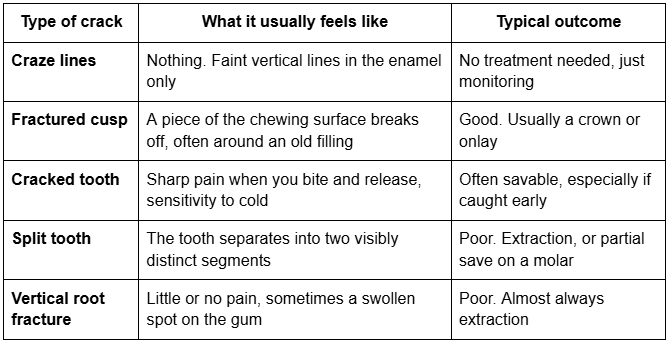
Here is the part nobody enjoys hearing: a cracked tooth cannot heal itself. Bone knits back together. Enamel and dentin do not. Once a crack starts, the only question is whether it gets protected or gets bigger.
The good news is that the top three rows of that table cover the large majority of what we see in the office.
The most reliable signal is pain when you release your bite, not when you clamp down. Bite on something firm, and the crack squeezes shut. Let go, and the two halves spring apart, the fluid inside the dentin tubules moves, and you get that quick zap. If you have been chewing on one side of your mouth for a few weeks without consciously deciding to, that is your body telling you something.
Other things patients describe:
That last one is real. We have seen teeth split down the middle with no symptoms whatsoever, and one of the more common comments on patient forums is some version of "there was no pain, even when the thing was in two pieces." Cracks are not obligated to hurt.
Finding the crack is often harder than fixing it, because a fine vertical crack runs parallel to the X-ray beam and simply does not show up on a standard radiograph. That is why a cracked tooth can go a year or more without a diagnosis.
So we look at it from several angles instead. At Nova Dental, that means the tools in our Woburn office: intraoral and extraoral cameras that put the tooth on a screen at high magnification, high magnification loupes, and Panorex digital X-rays with SafeBeam, which cut radiation exposure by 90 percent compared with traditional film. Our TRIOS 5 intraoral scanner captures a 3D model of the tooth in minutes, which matters later when a crown has to fit precisely over a tooth that is already compromised.
We also use methods that have nothing to do with technology. A bite stick isolates one cusp at a time until we find the one that reproduces your pain. Shining a light through the tooth from the side makes a crack show as a dark line, because the fracture blocks light transmission. Sometimes the only way to know is to remove an old filling and look at what is underneath it.
The screen matters more than people expect. Showing you the crack tends to make the treatment conversation much shorter than describing it.
If a tooth hurts when you bite and your X-ray came back clean, that is worth a proper look rather than another month of chewing on one side. A restorative exam at Nova Dental identifies which type of crack you have and what it would take to fix it.
There are four real repairs, and the crack's depth decides which one you get.
Dental bonding works for shallow enamel cracks, minor chips, and small fractured corners on front teeth. Dr. Guldalian applies a tooth-colored resin, shapes it, and cures it with ultraviolet light. One appointment, usually 30 to 60 minutes per tooth, and no drilling. It is the least invasive option available, and it is also the most limited. Bonding covers a crack. It does not hold a tooth together.
A composite filling is the option when a crack has taken a small piece of the chewing surface with it but has not reached the nerve. Composite bonds directly to the tooth structure, which is why it has largely replaced amalgam for this kind of repair. It preserves more of the natural tooth than a crown does.
A crown is the standard fix for a genuine cracked tooth, meaning a crack that runs vertically into the dentin and flexes when you chew. Think of an old wooden barrel. The staves are held together by a metal hoop, and without the hoop the whole thing comes apart under pressure. A crown works the same way, wrapping the entire tooth so the crack physically cannot open. That is the mechanism. It is not cosmetic cover-up, it is structural.
Dr. Guldalian's prosthodontic training shows up in the material choice here. Porcelain for front teeth where shade matching matters most, zirconia when the tooth takes heavy chewing force, gold for back molars where longevity beats appearance.
Root canal treatment plus a crown is required when the crack has reached the pulp, the chamber of nerve and blood vessels at the center of the tooth. The inflamed tissue is removed, the canal is sealed, and a crown goes on top. A tooth that has had a root canal is more brittle than it was before, so the crown is not optional in this scenario.
For a cracked front tooth where appearance is the main concern and the structure is sound, porcelain veneers are sometimes a better answer than a crown, because they conserve more enamel.
No, and the number of people who assume otherwise is high. Root canal treatment is only needed when the pulp is inflamed past the point of recovery.
There is decent evidence for optimism here. A three-year study of nearly 3,000 posterior teeth with visible cracks, run by the National Dental Practice-Based Research Network, followed both treated and untreated cracked teeth. Among teeth where the patient had biting pain or spontaneous pain at the start, the large majority saw that pain resolve, and most stayed resolved.
A cracked tooth caught while the nerve is still healthy often needs a crown and nothing more. The same tooth, six months later, after the crack has worked its way deeper, is a different conversation.
A cracked tooth generally cannot be saved once the crack extends below the gum line, splits the tooth into separate mobile segments, or starts in the root and travels upward.
Delta Dental's breakdown of crack types puts it plainly: split teeth and vertical root fractures usually end in extraction. With a split molar there is sometimes a partial save available, where the damaged root is removed and the remaining portion is treated and crowned. That is a case-by-case call, not a general rule.
If the tooth does come out, the replacement conversation starts immediately, because the neighboring teeth begin drifting into the gap within months. A dental implant is the option that preserves the jawbone, since the titanium post stimulates bone the way a natural root does. A bridge is faster and less expensive. Either way, rebuilding a damaged bite is about function first and appearance second.
Statistically, less than you might fear. Practically, more than you want.
In that same national registry, about 3 percent of cracked teeth went on to fracture within three years, and roughly 12 percent showed measurable crack progression. Those are small numbers, and they are worth knowing, because plenty of dental content online implies your tooth is going to shatter next Tuesday.
The catch is that you cannot tell from the outside which group your tooth is in. And the cost curve is brutally one-directional. A crack that needs a filling today may need a crown next year. A crack that needs a crown today may need a root canal and a crown after that. Nothing about a crack ever gets easier or cheaper with time.
Cost tracks directly with how deep the crack has gone, which is why the timing question and the money question are the same question.
The ladder, from least to most expensive: bonding, composite filling, crown, root canal plus crown, extraction plus implant. Each rung up represents a crack that was allowed to travel further.
For patients without insurance, Nova Dental offers a VIP membership plan that covers preventive visits at a set annual rate. Dr. Guldalian is independently practicing with no corporate quotas to hit, which is worth mentioning here specifically because it means nobody is going to talk you into a crown you do not need.
Most cracks come from repeated stress rather than a single dramatic event.
If you grind, a custom night guard is the single highest-value thing you can do for your teeth, and it costs a small fraction of one crown. Research on cracked teeth has consistently found that patients with untreated grinding habits have worse long-term outcomes after treatment. Protecting the repair matters as much as making it.
If several teeth have large failing restorations, prosthodontic treatment planning looks at the bite as a whole rather than fixing teeth one crisis at a time.
Most cracked teeth are still savable, and the ones treated early are the cheapest to fix. Dr. Talar Guldalian will show you the crack on screen, explain what she is seeing, and give you the honest range of options before you commit to anything.
Call (781) 369-5722 or send us a message. We are at 304 Cambridge Road, Suite 340 in Woburn, serving patients from Winchester, Arlington, and Lexington.
Can a cracked tooth heal on its own?
No. A cracked tooth cannot heal on its own, because enamel and dentin do not regenerate the way bone does. Very shallow enamel cracks called craze lines may never need treatment, but they do not repair themselves either. Any crack that reaches the dentin requires professional treatment to stop it from progressing.
Is a cracked tooth a dental emergency?
A cracked tooth is urgent but not always an emergency. Seek same-day care if you have severe pain, visible swelling, bleeding, or a piece of tooth that has broken off. If the pain is intermittent and mild, schedule an exam within the next week or two rather than waiting for it to worsen.
Can you fix a cracked tooth without a crown
Sometimes. Shallow cracks limited to the enamel can be treated with dental bonding, and cracks affecting a small portion of the chewing surface can be repaired with a composite filling. A crown becomes necessary once the crack runs deep enough that the tooth flexes under chewing pressure, because only full coverage prevents the crack from opening.
How long can you wait to fix a cracked tooth?
There is no safe waiting period, though most cracks progress slowly. Research following nearly 3,000 cracked teeth found that about 3 percent fractured and 12 percent progressed within three years. The risk is not that the tooth shatters tomorrow, it is that the treatment required grows more invasive and more expensive the longer the crack goes untreated.
Will a cracked tooth show up on an X-ray?
Often not. A vertical crack runs in the same plane as the X-ray beam, which makes it nearly invisible on a standard radiograph. Dentists diagnose cracks using magnification, intraoral cameras, bite stick testing, transillumination, and sometimes by removing an existing filling to inspect the tooth structure underneath.