.png)
Dental implants are widely considered the gold standard for replacing missing teeth. They look natural, restore full chewing power, and prevent bone loss. However, for patients in Woburn, Winchester, and Burlington who suffer from chronic teeth grinding (bruxism), the decision to get implants often comes with a big question: “Will I just break these expensive new teeth?”
The short answer is: Yes, you can get dental implants if you grind your teeth—but you need the right protection strategy.
At Nova Dental, Dr. Talar Guldalian specializes in implant dentistry and prosthodontics. This means she doesn’t just place teeth; she specializes in the complex mechanics of how your jaw, muscles, and teeth work together. Below, we explain why grinding poses a risk to implants and exactly how we protect your investment.
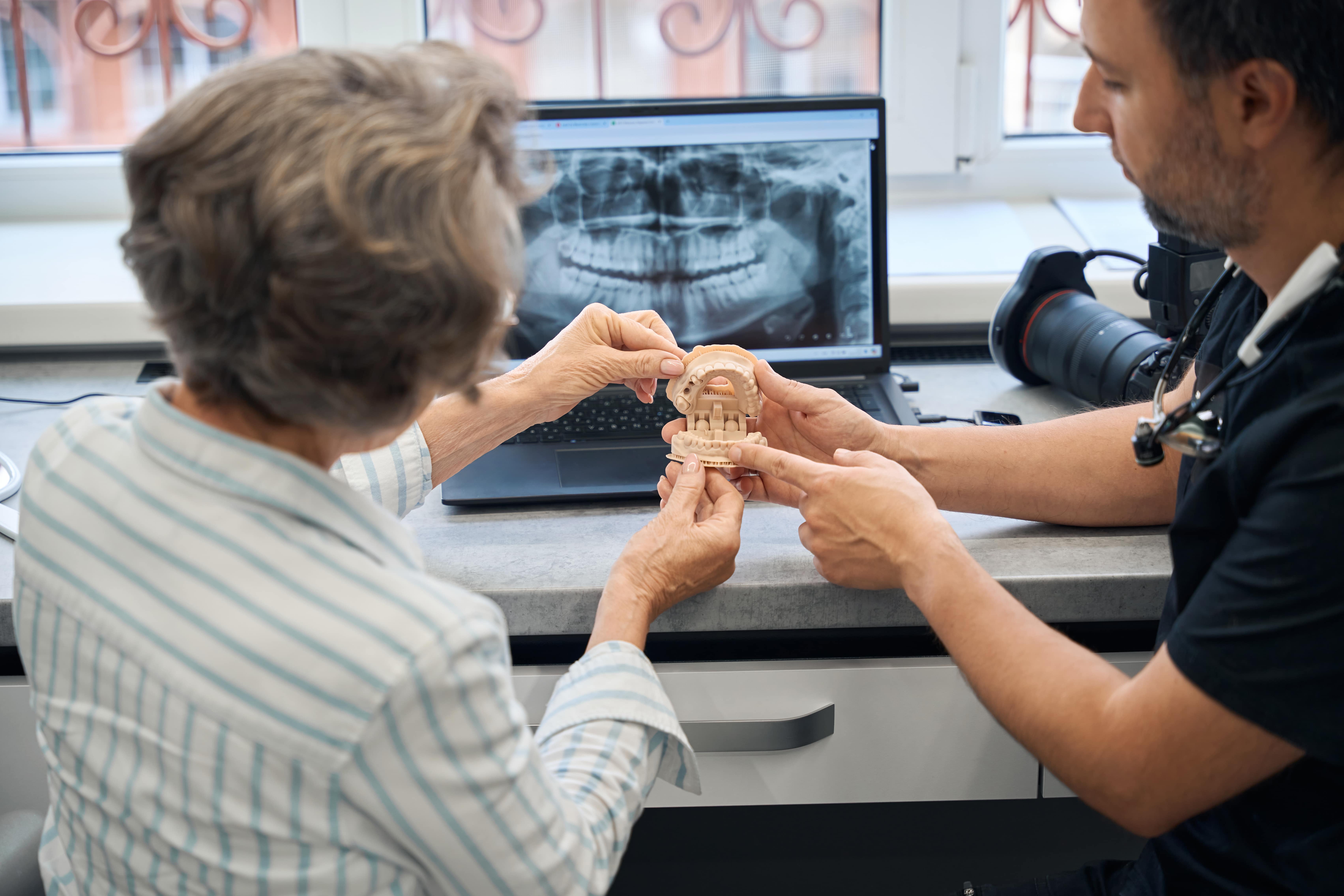
To understand why grinding is dangerous for implants, you first need to understand a key difference in anatomy between a natural tooth and an implant.
Your natural tooth isn't actually fused directly to your jawbone. It is suspended in the socket by a microscopic tissue called the Periodontal Ligament (PDL). This ligament acts like a shock absorber or a car’s suspension system. When you bite down hard or grind, the tooth can move slightly (micromovement) to absorb and dissipate that stress.
Dental implants work through a process called osseointegration, meaning the titanium post fuses directly to the bone. There is no ligament. There is no "give."
Because implants are rigid, any force applied to them, like the massive pressure generated during sleep grinding, is not cushioned. Instead, that shock is transferred directly to the porcelain crown, the connecting screw, and the surrounding jawbone. Without proper management, this direct force is what causes complications.
Many patients in our Woburn office tell us, "I don't grind my teeth!", only to be surprised when we show them the wear patterns on their molars.
Because bruxism often happens during deep sleep (Sleep Bruxism), you may be completely unaware you are doing it. In fact, studies suggest that around 8-13% of people grind their teeth frequently.
If you are considering dental implants, watch out for these warning signs:
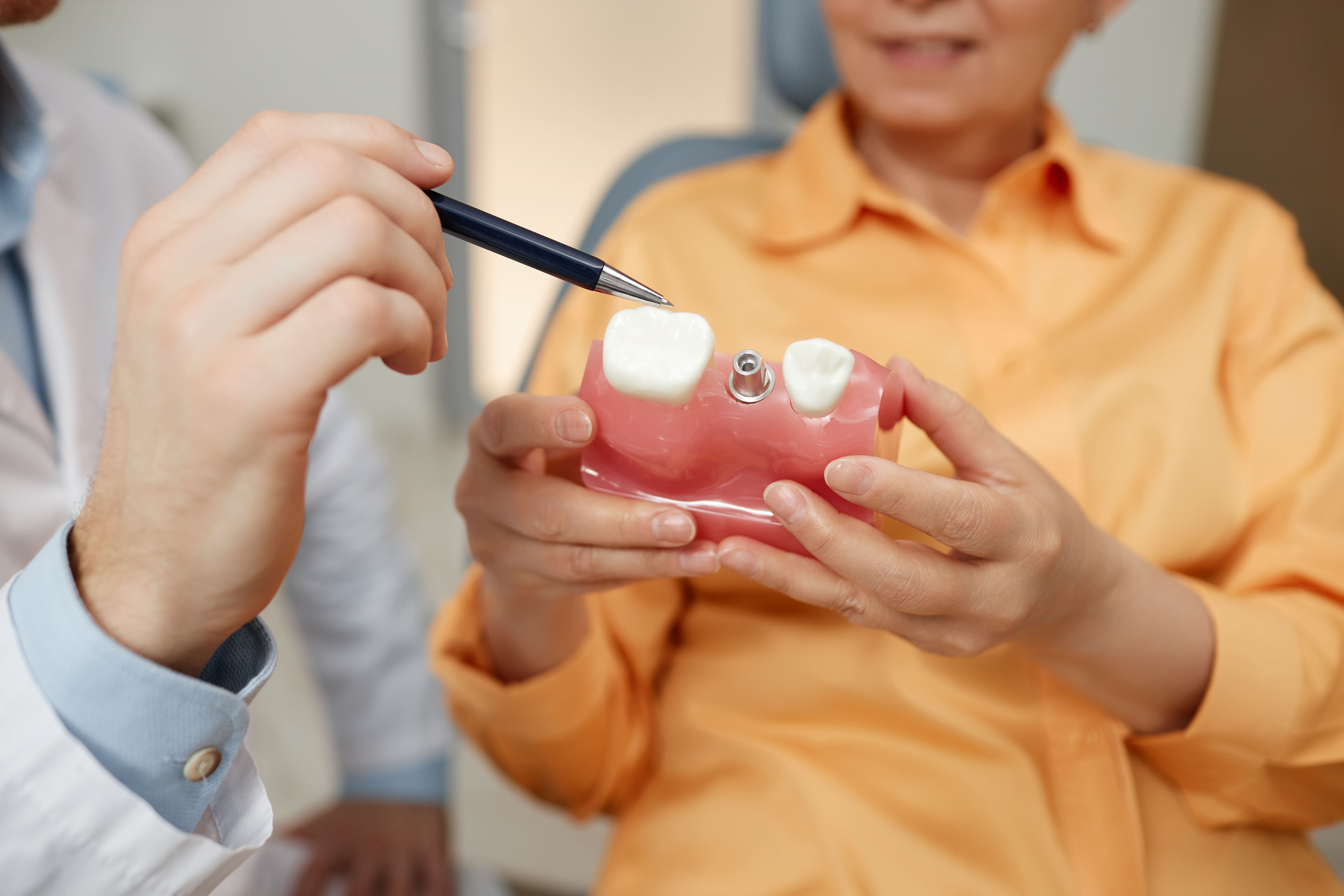
Because your implant cannot move to absorb the pressure of grinding, that energy has to go somewhere. In a study done across 450 patients who had 640 dental implants, it was found that patients who reported regular bruxism had a 10-year implant survival rate of about 92%, which is lower than the 95-98% survival rate for all patients.
Without protection, this excessive force usually leads to one of three mechanical failures:
The most common issue we see is the loosening of the internal screw. The dental crown (the white tooth part) is connected to the implant root by a small abutment screw. Continuous grinding vibrations can cause this screw to back out, making the tooth feel loose. In severe cases, the screw can actually snap inside the implant, which is a complex issue to fix.
While dental ceramics are incredibly strong, they are not indestructible. The "shearing" force of grinding—sliding teeth back and forth against each other—is particularly damaging to porcelain. This can cause the cosmetic coating of the crown to chip, fracture, or pop off entirely.
This is the most serious long-term risk. When an implant is subjected to constant overload, the surrounding jawbone can become traumatized. This stress can cause the bone to recede or pull away from the implant neck (similar to gum disease). If enough bone is lost, the implant itself loses stability and may need to be removed.
The existence of bruxism doesn’t mean you are disqualified from getting dental implants. It simply means Dr. Guldalian will take extra precautions during the planning and restoration phases to ensure longevity.
Here is the three-step protocol we use at Nova Dental for patients who grind their teeth:
1. The "Safety Belt": Custom-Fitted Nightguards If you have dental implants and you grind your teeth, a custom nightguard is not optional—it is essential. Unlike over-the-counter "boil and bite" guards found at drugstores, a professional nightguard is precision-molded to your specific bite.
2. Indestructible Materials (Zirconia) For patients with heavy bite force, we may recommend using Zirconia crowns instead of traditional porcelain fused to metal. Zirconia is a type of crystal that is incredibly durable—often called "ceramic steel." It is virtually impossible to chip or fracture, even under the pressure of grinding.
3. Strategic Bite Adjustment When placing the final crown, Dr. Guldalian can adjust the bite so that the implant makes slightly "lighter" contact than your natural teeth. This ensures that when you bite down lightly, your natural teeth absorb the force. The implant only engages fully when you bite down hard, reducing the daily wear and tear on the screw.

This is where the choice of provider becomes critical. While many general dentists place implants, Dr. Talar Guldalian is a Prosthodontist—a specialist with advanced training specifically in the restoration and replacement of teeth.
Prosthodontics is essentially "dental engineering." A prosthodontist focuses heavily on occlusion (how your teeth fit together) and bite dynamics. When you are dealing with the complex forces of bruxism, you need a specialist who understands how to engineer a bite that distributes force evenly.
For a patient in Woburn or Winchester with a history of grinding, seeing a prosthodontist offers the highest chance of long-term implant survival. We don't just fill the gap; we design a system that can withstand your jaw's natural strength.
Yes, without proper protection, teeth grinding (bruxism) is a leading cause of dental implant complications. The excessive force can cause the bone around the implant to recede (peri-implantitis), loosen the abutment screw, or chip the porcelain crown. However, with a custom nightguard and proper bite adjustment, the success rate remains very high.
If you have a history of grinding, wearing a nightguard is the single most important thing you can do to protect your investment. Think of it as an insurance policy for your new smile. It creates a protective barrier that absorbs the pressure, ensuring that your implants—and your natural teeth—aren't damaged while you sleep.
If your implant feels loose, do not wiggle it. Contact Nova Dental immediately. In many cases of bruxism, the implant itself is still solid in the bone, but the small screw connecting the tooth to the implant has loosened due to vibration. This is often an easy fix (tightening the screw), but if left untreated, the screw can snap or damage the internal threads, leading to much bigger problems.
Living with bruxism doesn't mean you have to settle for gaps in your smile or uncomfortable dentures. It simply means you need a dental partner who understands the mechanics of your jaw.
At Nova Dental, we believe that a successful implant isn't just about the surgery—it's about the long-term engineering of your bite. By combining Dr. Guldalian’s prosthodontic expertise with durable materials like Zirconia and custom-fitted nightguards, we help heavy grinders enjoy beautiful, permanent teeth for decades.
Whether you are looking to get your first dental implant or you have an existing implant that feels "off" due to grinding, we are here to help.
Dr. Talar Guldalian and the team at Nova Dental serve patients across Woburn, Winchester, Burlington, and the surrounding areas.
Ready to restore your smile with confidence?