.png)
Gum swelling usually goes down within one to two weeks. Minor causes like trapped food or a brushing injury settle in one to three days. Plaque-driven gingivitis improves within 7 to 14 days of consistent brushing, flossing, and a professional cleaning. Swelling from an abscess or infection will not resolve on its own and needs dental treatment.
That range is wide for a reason. A popcorn hull wedged under the gumline and a tooth infection can look almost identical in the mirror on day one. What separates them is what happens over the next 72 hours.
Most gum swelling clears within 24 hours to two weeks, depending on the cause. Here is what each situation typically looks like:
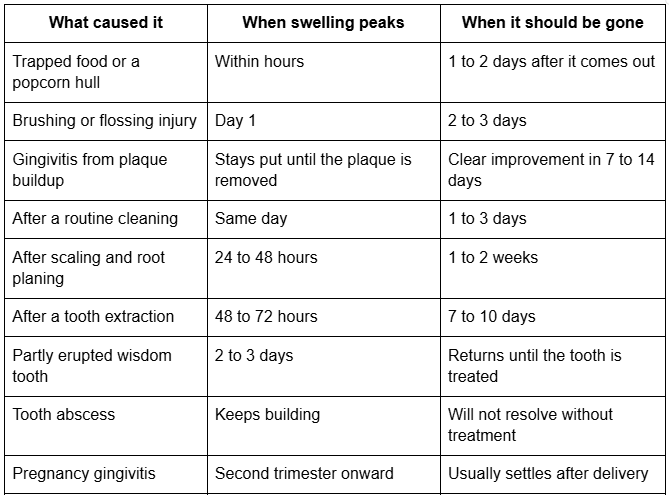
One thing worth knowing before you start counting days: swelling going down and gum tissue being healthy are two different finish lines. Puffiness can fade while the bacteria underneath keep working. That gap is why gum problems so often come back a few weeks later in the same spot. If you want the longer view on tissue recovery, we covered what a full gum recovery actually involves in a separate guide.
Swelling that has not moved in a week usually means the thing causing it is still there. Nine times out of ten, that is plaque or tartar sitting below the gumline where a toothbrush cannot reach.
Here is the part most people miss. Plaque is soft and you can brush it away. Once it hardens into tartar, brushing does nothing to it. You can floss twice a day for two straight weeks and the gum will stay puffy, because the deposit irritating it has not budged. That is not a hygiene failure on your part. It is a mechanical problem that needs an instrument.
Gingivitis, the mildest form of gum disease, is a reversible condition, which is genuinely good news. It also means the clock matters. Roughly 42% of adults aged 30 and older already have periodontitis, the stage where bone around the tooth starts to go, and that stage cannot be reversed. The window between those two states is where most swollen gums live.
The general medical guidance lines up with what we see in the chair: changes to your gums that last longer than two weeks are worth having looked at. Two weeks is the outer edge, not the target.
If you are unsure which you are dealing with, the difference between soft plaque and hardened tartar is a useful place to start.
Swelling goes down when the irritant leaves. Everything else buys comfort while you wait.
Salt water rinses genuinely help. So does a cold compress on the outside of the cheek. Both reduce how the gum feels and neither one removes plaque, tartar, a food fragment, or an infection. Think of a splinter in your finger. Ice makes the throbbing tolerable, but nothing settles until the splinter comes out.
What does move the needle:
A professional cleaning usually clears up gingivitis, as long as the hygiene continues once you are home. That is the practical fix for the majority of swollen gums we see. A cleaning with our hygienist takes about an hour and removes what your toothbrush structurally cannot.
Two weeks of careful brushing and nothing has changed? The deposit causing it is almost certainly below the gumline. One look tells us which it is, and most causes are simple to treat once they have a name.
Expect one to two weeks after scaling and root planing, and seven to ten days after an extraction. Both peak earlier than people expect and then taper.
After a deep cleaning, gums are often puffier and more tender on day two than they were walking out of the office. That is normal. The tissue was inflamed and packed with bacteria, and clearing it out provokes a short-term response before things settle. Tenderness while brushing for the first several days is expected. Tenderness at two weeks is not.
After an extraction, swelling peaks at 48 to 72 hours, then drops off steadily. The rule of thumb we give patients is simple: swelling that increases on day three is normal, and swelling that increases on day six is a phone call.
Deep cleaning also does something you can watch for. As bacteria clear, scaling and root planing removes bacteria below the gumline so the tissue can tighten back against the tooth. Gums that look slightly lower afterward are usually gums that stopped being swollen, not gums that receded. If you have a deep cleaning scheduled and are wondering what to expect, here is the soreness people report after a deep cleaning.
Swelling around a single tooth either clears in two to three days or it keeps coming back. There is not much middle ground, and which one it does tells you a lot.
If something was trapped, removing it resolves the swelling almost immediately. Flossing that one spot carefully, then rinsing, usually settles it inside 48 hours.
If it fades and returns to the same tooth every few weeks, something structural is driving it: an abscess at the root, a partly erupted wisdom tooth with a flap of gum over it, a cracked filling, or a crown margin that traps bacteria. Recurring swelling in one location is the clearest signal there is, and it will not solve itself.
For the full picture, see our breakdown of localized gum swelling. If the swelling has a visible white or yellow center, read about a gum boil instead, because that one has a shorter fuse.
Waiting stops being reasonable the moment the swelling spreads past the gum or brings company.
Call the office within a day or two if you notice:
Go to an emergency room, not a dental office, if you have a fever along with facial swelling and cannot reach your dentist, or if you have trouble breathing or swallowing. Those symptoms can mean the infection has moved into the jaw, throat, or neck. This is rare. It is also the one scenario where hours matter.
Pain is not the deciding factor here. Plenty of serious gum infections are painless for weeks, which is exactly why they get ignored.
The first appointment is about finding the cause, not treating it blind. Dr. Talar Guldalian examines the tissue, checks the depth of the pockets around the affected teeth, and takes digital scans that she walks you through on screen so you can see what she is seeing.
From there the path is usually one of three. If it is plaque and early gingivitis, a cleaning handles it. If tartar has worked its way below the gumline, periodontal therapy clears it out and the tissue reattaches over the following weeks. If the source is inside the tooth, restorative treatment addresses that directly.
Dr. Guldalian earned her DMD magna cum laude from Boston University's Goldman School of Dental Medicine and completed advanced training in general dentistry and prosthodontics at UCSF. She has been named a Boston Magazine Top Dentist every year from 2020 through 2025, and she teaches as a faculty member at the Spear Education Center. You can read more about her background and training if you want the full picture before booking.
We see patients from Woburn, Winchester, Burlington, and Lexington, and there are no quotas here. If your gums need a cleaning and nothing more, that is what we will tell you.
Swelling that keeps coming back is telling you something. Finding out what takes one appointment, and most causes are straightforward to treat once they have a name.
Call (781) 369-5722 or stop by 304 Cambridge Road, Suite 340. We see patients from Woburn, Winchester, Burlington, and Lexington.
How long should gum swelling last before I worry?
Give it a week of consistent brushing, flossing, and salt water rinses. If there is no visible improvement by day seven, or if the swelling is worse than when it started, book an exam. Two weeks is the outer limit before gum changes should be professionally evaluated.
Can swollen gums go away on their own?
Sometimes. Swelling from trapped food, a brushing injury, or mild irritation usually clears within a few days once the cause is removed. Swelling from hardened tartar, an abscess, or an impacted tooth will not resolve without treatment, no matter how carefully you brush.
How long does gum swelling take to go down after a deep cleaning?
One to two weeks. Gums are often more tender on the second day than immediately after the appointment, which is a normal part of the tissue settling. Tenderness that is still significant at the two-week mark should be checked.
Why are my gums swollen but not painful?
Gingivitis and early gum infections are frequently painless. Swelling, redness, and bleeding while brushing are usually the only signs, which is why gum disease progresses undetected so often. Painless swelling still deserves an exam.
Does salt water actually reduce gum swelling?
Yes, modestly. A warm salt water rinse reduces bacteria and soothes inflamed tissue, and it is a reasonable thing to do two or three times a day. It does not remove plaque or tartar, so it eases symptoms rather than fixing the underlying cause.