.png)
Canker sores are small, shallow ulcers that form on the soft tissue inside your mouth. They have no single known cause. They develop when an underlying predisposition, such as a nutritional deficiency, a genetic tendency, or an immune response, meets a trigger, such as a cheek bite, an acidic meal, or a stretch of poor sleep. Canker sores are not contagious and are not caused by a virus.
That two-part answer matters more than it sounds. Most articles hand you a list of ten triggers and leave you to guess which one is yours. The more useful question is why your mouth is vulnerable in the first place, because that is the part you can actually change.
Here is what causes them, why some people get one a year and others get one a week, and the point at which a sore stops being ordinary.
A canker sore is an aphthous ulcer, which means a break in the mucous membrane lining your mouth. It is a wound, not an infection.
They form on the soft, moveable tissue: the inside of your cheeks and lips, the sides and underside of your tongue, the floor of the mouth, and the base of the gums. They do not form on the hard palate or the outside of your lips. Most look the same, a round or oval crater with a white or yellow center and an angry red border.
They are also common. Recurrent aphthous stomatitis affects roughly 20 percent of the general population, and they tend to show up first around puberty, when growth-related hormones are higher.
There are three types, and knowing which one you get is genuinely useful:
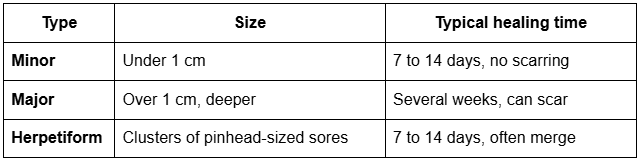
Roughly 8 out of 10 canker sores are the minor kind. If yours are always small and always gone inside two weeks, that pattern itself is reassuring.
No. They are different conditions with different causes, and confusing them sends people looking for the wrong answer.
The simplest test is location. If it is on the outside of your lip, it is not a canker sore.
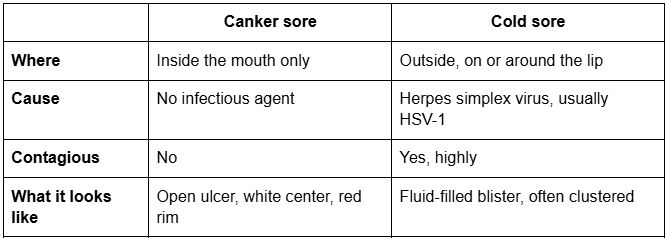
This is worth being clear about, because a lot of patients arrive convinced they have caught something or passed something to a partner. You cannot catch a canker sore. There is no virus or bacteria to spread.
Recurrence almost always means you have a standing predisposition, not repeated bad luck.
Think of it as two separate things working together.
The predisposition is what keeps the tissue vulnerable: genetics, a nutritional gap, a hormonal cycle, an immune tendency. It sits in the background for months or years.
The trigger is what actually starts the sore: the cheek bite, the bowl of tomato soup, the week you slept five hours a night.
People with recurring sores typically get them two to three times a year, and the tendency runs in families. If a parent or sibling gets them, your odds go up considerably.
That framing changes what you do about it. Chasing triggers one at a time is exhausting and rarely works. Finding the predisposition usually cuts the frequency across the board.
When a patient tells me they are getting three a month, I am not looking for one cause. I am looking for what is keeping the tissue vulnerable in the first place, and then for whatever keeps setting it off.
The fastest way to find both is unglamorous. Keep a note on your phone for two weeks. Date, location in your mouth, what you ate that day, what was going on in your life. Patterns show up quickly, and they are almost never what people expect.
If you have one right now and mostly want it to stop hurting, we cover shortening how long each one lasts separately. This article is about why they showed up.
The systemic causes are the ones people miss, because nothing about them feels connected to your mouth.
Nutritional deficiency. This is the big one for frequent sufferers. Low levels of vitamin B12, vitamin D, folate, iron, or zinc are consistently linked to recurrent ulcers. Deficiency is common in vegetarians and vegans, in people with absorption issues, and in anyone who has changed their diet significantly in the past year. A blood panel from your physician settles it in a week.
Stress and sleep debt. Stress does not cause a sore directly. It changes immune activity, and canker sores appear to be driven by an immune response in the mucosal tissue. That is why they cluster around finals, deadlines, moves, and new babies. Sleep deprivation does the same thing through the same route.
Hormonal cycles. Some women get sores on a monthly schedule, tied to the point in their cycle. If yours arrive at a predictable time of month, that is the answer and you can stop looking.
Medications. NSAIDs like ibuprofen and naproxen, beta-blockers, and some immunosuppressants list mouth ulcers as a side effect. If your sores started within a few months of a new prescription, mention the timing to your prescribing doctor.
Underlying conditions. Celiac disease, Crohn's disease, ulcerative colitis, and Behçet's syndrome can all present with recurring mouth ulcers. This is worth naming, but it is worth keeping in proportion. These are rarely the explanation. They are simply the reason that sores appearing three or more times a month deserve a proper look rather than another tube of gel.
Yes, and this is the category almost nobody checks, because you cannot see most of it yourself.
Cheek and lip bites. The single most common trigger. One clumsy bite while eating, and a sore appears in that exact spot two days later. If yours always show up in the same place, this is usually why.
A rough or failing restoration. A chipped filling edge, a worn margin, or a sharp corner on an old silver filling catches the same patch of tissue every time you chew. Patients live with this for years. It takes about ten minutes to fix, and the edge can be smoothed or replaced during a routine visit.
Braces, retainers, and appliances. Brackets and wires rub. This is the classic teenage pattern, and it is why sores often start at 13 and stop when the braces come off. Orthodontic wax on the offending bracket solves most of it. Persistent sores in kids and teens in braces are worth checking, because a wire that is genuinely out of position needs adjusting, not wax.
Aggressive brushing. A hard-bristled brush and heavy pressure scrapes tissue. Soft bristles, less force. Your enamel prefers it too.
SLS in your toothpaste. Sodium lauryl sulfate is the foaming agent in most mainstream toothpastes, and it irritates soft tissue in people who are sensitive to it. This is the highest-value practical change on this page, because for some people it stops recurrence almost entirely. Sensodyne Pronamel, Biotène, and Hello are widely available SLS-free options. Give it six weeks before judging.
Acidic and abrasive foods. Tomatoes, citrus, vinegar, pineapple, salty crisps, and anything with a sharp crust. These rarely cause a sore from nothing, but they aggravate tissue that is already irritated.
Here is the analogy I use in the chair. A rough filling edge is a seam inside a shoe. Your foot is not defective. Something is rubbing, in the same place, every day. Find the seam and the blister stops coming back.
If your sores keep showing up in the same spot, there is usually something physical causing it.
Dr. Guldalian can check your restorations, appliance fit, and brushing technique in a single visit and tell you what is actually rubbing.
No pressure, no treatment plan you did not ask for.
Most canker sores need nothing but time. These are the exceptions:
What an appointment at Nova Dental actually involves is less dramatic than people expect. Dr. Guldalian checks for sharp enamel edges and rough restoration margins, looks at how any appliance sits against tissue, reviews your brushing technique and what toothpaste you are using, and asks about diet and timing. Where the pattern points to a deficiency, we say so and recommend bloodwork through your physician rather than guessing at supplements.
She trained in general dentistry and later in prosthodontics at UCSF, which means restoration margins and how appliances meet soft tissue are exactly the details she is trained to catch. Most of this gets checked during a routine exam anyway, which is a decent argument for not skipping your six-month visit.
You cannot prevent every one. You can usually cut how often they happen, once you know which cause is yours.
Recurring canker sores are worth a conversation.
Bring your pattern to us: how often, where in your mouth, and what was going on at the time. We will help you work out whether it is mechanical, dietary, or something worth ruling out with your physician.
Book a visit with Dr. Guldalian
Nova Dental is independently owned, so nobody here has a quota to fill.
Are canker sores contagious?
No. Canker sores are not contagious and cannot be spread through kissing, sharing drinks, or utensils. They are not caused by a virus or bacteria. Cold sores are contagious, but they appear outside the mouth on or around the lips and are caused by the herpes simplex virus.
What vitamin deficiency causes canker sores?
Low levels of vitamin B12, folate, iron, zinc, and vitamin D are all linked to recurrent canker sores. Deficiency is a common cause in people who get sores more than a few times a year. A blood panel ordered by your physician can confirm which, if any, applies to you.
Can stress alone cause a canker sore?
Stress rarely causes a sore by itself. It alters immune activity and lowers your tissue's resistance, which makes an existing trigger more likely to produce a sore. Sleep deprivation has a similar effect. This is why canker sores cluster around deadlines, exams, and other high-pressure stretches.
How long does a canker sore take to heal?
Minor canker sores heal in 7 to 14 days without scarring, and the first three or four days are the most painful. Major canker sores, larger than about 1 cm, can take several weeks and may leave a small scar. Any sore lasting beyond two weeks should be examined.
Do canker sores mean something is wrong with my immune system?
Usually no. Most recurring canker sores trace back to a nutritional gap, a mechanical irritant, or stress rather than an immune disorder. Conditions such as celiac disease, Crohn's disease, and Behçet's syndrome can cause recurring ulcers, but they are uncommon explanations and come with other symptoms.